In B2B sales, what works today might not work tomorrow. Markets shift, buyer behavior evolves, and strategies that once drove results can lose their edge. That’s why continuous testing and optimization are crucial for both inbound and outbound efforts. By experimenting with tactics, analyzing performance, and staying agile, businesses can adapt and grow even in dynamic markets.
In this article, we explore actionable steps for testing and optimizing your inbound and outbound strategies, helping you maintain relevance and drive consistent revenue growth.
Why Testing and Optimization Matter
No matter how well-designed your strategies are, they’re based on assumptions that may not hold true over time. Testing and optimization allow you to:
- Validate your approach: determine what resonates with your audience and what doesn’t
- Improve ROI: focus resources on tactics that deliver the best results
- Stay competitive: adapt quickly to changes in buyer behavior or market conditions.
Step 1: A/B Testing for Continuous Improvement
A/B testing (or split testing) is one of the most effective ways to fine-tune both inbound and outbound strategies. It involves comparing two versions of a tactic—such as an email, landing page, or ad—to see which performs better.
A/B Testing for Inbound
Test content formats: experiment with different types of content, like blog posts, videos, and eBooks, to see which drives the most engagement (example: test whether a video explainer outperforms a blog post in generating leads).
Optimize call-to-action (CTA): test different CTA buttons on your landing pages. For instance, compare “Download Now” vs. “Get Your Free Guide” to see which gets more clicks.
Refine headlines and keywords: A/B test blog titles or meta descriptions to improve click-through rates. Similarly, test SEO keywords to identify those that bring in the highest-quality traffic.
A/B Testing for Outbound
Experiment with email subject lines: test variations to find what grabs attention. For example, compare “Quick Question, [Name]” vs. “How [Solution] Can Help [Pain Point].”
Personalization levels: compare fully personalized emails with semi-automated ones to balance scalability and engagement.
Adjust timing and cadence: test different times of day or days of the week to determine when prospects are most likely to engage.
Step 2: Use Data Insights to Refine Strategies
Your CRM, marketing automation platform, and analytics tools hold a wealth of data that can inform smarter decisions. Here’s how to leverage these insights:
Analyze conversion rates:
Track how leads progress through the funnel and identify where drop-offs occur. For example, if many leads fail to convert after the awareness stage, your messaging might need adjustment.
Identify top-performing channels:
Use analytics tools to determine which channels (e.g., LinkedIn, email, organic search) generate the highest-quality leads. Double down on what’s working and refine or cut what isn’t.
Monitor engagement metrics:
Metrics like email open rates, click-through rates, and website session duration can reveal how well your messaging resonates.
Segment your audience:
Break down performance data by industry, company size, or role to tailor your strategies further. For instance, if mid-market prospects respond differently than enterprise prospects, adjust your approach accordingly.
Step 3: Build Agility into Your Tactics
Staying relevant requires flexibility. Here’s how to keep your inbound and outbound strategies adaptable:
1.
Experiment with new channels:
Don’t hesitate to test emerging platforms or tools. For example, consider trying to engage via chatbots or video prospecting for outbound.
2.
Regularly refresh content:
Update existing blog posts, case studies, and whitepapers with current data and insights to keep them relevant and engaging.
3.
Iterate on sales sequences:
Outbound tactics like email cadences should evolve based on what’s working. For example, if follow-up emails outperform initial outreach, adjust your sequence to emphasize follow-ups.
4.
Stay in tune with buyer trends:
Keep an eye on industry reports, buyer surveys, and competitor strategies to anticipate changes in your market.
If testing feels busy but results feel flat, the issue is usually focus, not effort.
At Vaneco, we help founder-led companies turn inbound and outbound testing into clear revenue learning loops.
See how the Revenue Accelerator Program helps teams test with purpose instead of guessing.
Takeaway: Practical Steps for Effective Optimization
Testing and optimization aren’t one-time tasks—they’re an ongoing process. By consistently experimenting with tactics, analyzing performance, and adapting to new insights, you can maintain a competitive edge and ensure your strategies stay effective.
Here’s your roadmap:
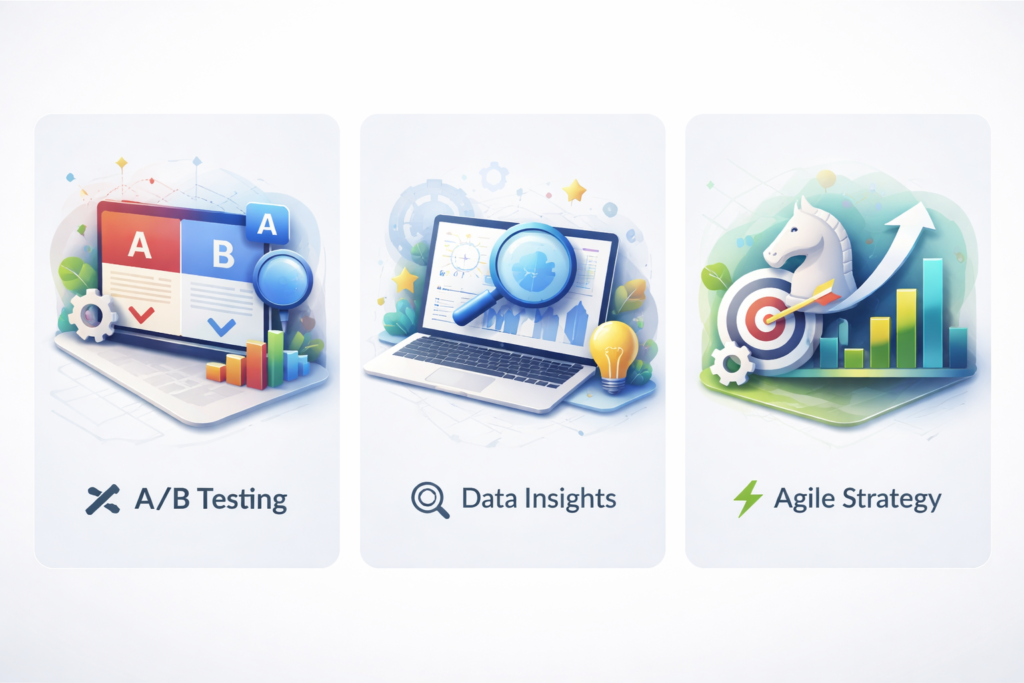
- Use A/B testing to refine both inbound and outbound messaging, formats, and timing.
- Leverage data insights to identify what’s working, where to improve, and how to tailor strategies by audience.
- Build agility into your tactics to quickly respond to market changes and emerging opportunities.
FAQ: Testing and Optimization in B2B
Why do most optimization efforts fail?
Because they are not tied to a clear hypothesis or revenue outcome.
How often should inbound and outbound be tested?
Continuously, but in small, focused experiments.
What should be optimized first?
The biggest drop-off points in the buyer journey.
Does optimization require new tools?
No. It requires discipline and clarity.
At Vaneco,we understand that sustainable growth requires constant refinement. Our Revenue Accelerator Program emphasizes the importance of data-driven decision-making, helping businesses test and optimize their inbound and outbound strategies. From designing A/B tests to leveraging CRM insights, we guide you in building scalable processes that adapt to evolving markets.